
Blog Series: What Makes Great Boards Great: A Practical Exploration
Series Introduction
Over the course of my career, I’ve served as a director on both for-profit and nonprofit boards, attending countless quarterly board meetings and learning firsthand what truly drives effective governance. My formal training as a Chartered Director, obtained through McMaster University and the Conference Board of Canada, provided a robust foundation in governance theory. But it’s the real-world interplay—the human element in the boardroom—that ultimately separates high-performing boards from ineffective ones.
This series, “What Makes Good Boards Great,” draws on my 25+ years of boardroom experience and the lessons gleaned from seeing boards in action. In these articles, we’ll delve into the human dynamics that shape decision-making, the structural best practices that ensure accountability, and the strategic oversight that lifts an organization beyond routine administration. Whether you’re a seasoned director, a rising executive, or simply intrigued by corporate governance, these discussions aim to illuminate how truly effective boards function—and how each of us can contribute to that success.
Blog 1: “It Is the Human Element in the Board That Makes the Difference”
Introduction
Starting in an Unorthodox Way
I’m intentionally bypassing the usual technical basics of governance (committees, charters, regulatory compliance) to begin with the human element, a subject too often overlooked in board discussions. In subsequent articles, I’ll also shine a light on family-owned businesses and nonprofits, where board dynamics can differ drastically from larger public companies, yet frequently go unaddressed by mainstream governance guidance. This blend of “people-first” perspective and focus on family/nonprofit boards sets the stage for a more holistic understanding of what truly makes board governance effective.
Corporate boards assemble directors who, on paper, bring expertise, industry knowledge, and strategic acumen that should drive strong governance. Ideally, if each director boasts an IQ of 150, we’d expect a “super-team” with a collective genius surpassing any single individual. Yet we often encounter the paradox that 10 brilliant individuals on a dysfunctional board can collectively perform as if they have an “IQ below 100.” This paradox underscores the importance of the human element—the interpersonal relationships, social dynamics, trust, and intangible behaviors that either elevate a board’s function or drag it into groupthink or confusion.
Jeffrey Sonnenfeld’s seminal Harvard Business Review article, “What Makes Great Boards Great,” addresses precisely this phenomenon: boards that appear perfect on paper but suffer from poor chemistry and weak synergy. Conversely, boards that are not necessarily stacked with celebrity resumes but excel at candid communication and mutual respect can outperform even star-studded panels. This article delves into how human dynamics—far more than formal structures—ultimately determine a board’s success or failure.
- The Human Element: Defining “Collective IQ”
1.1 The IQ Metaphor
The statement “If you put 10 directors each with an IQ of 150 into a dysfunctional board, the collective IQ of the board is less than 100” is a pithy way to highlight that intelligence alone cannot guarantee effective board performance. Much like a brilliant sports team that lacks teamwork, the synergy (or lack thereof) can overshadow individual brilliance. If communications break down, or if interpersonal frictions hamper decisions, the board’s overall capacity to reason and act can collapse well below the sum of its parts.
1.2 Why Individual Excellence Is Not Enough
- Ego vs. Cooperation: High-powered directors may be used to leading, not necessarily collaborating. When they converge, ego clashes, hierarchical power plays, or reluctance to show vulnerability can stifle honest dialogue.
- Assumption of Competence: Each director might assume others are “covering” certain issues, resulting in blind spots if no one takes real ownership.
- Absence of Trust: If trust is lacking, directors hoard information, or second-guess one another’s motives, crippling the board’s collective intelligence.
Key Insight: The “collective IQ” is less about each director’s resume or intellectual horsepower and more about how they interact—whether they can fuse their knowledge into coherent, united judgments.
- Revisiting Jeffrey Sonnenfeld’s “What Makes Great Boards Great”
2.1 Overview of Sonnenfeld’s Key Points
In “What Makes Great Boards Great,” Sonnenfeld challenges the myth that structure (like size, independence, or committees) alone dictates effectiveness. While structure matters, the culture and relational aspects among board members often determine how well a board performs. Some major themes:
- Social Systems Over Rules: Great boards operate like high-functioning teams, with relationships that encourage open dissent, constructive debate, and swift resolution.
- Mutual Trust & Respect: Directors must be comfortable questioning each other without fear. This fosters robust interrogation of issues—a hallmark of strong governance.
- Candid Communication: Sonnenfeld observes that boards with back-channel alliances, unspoken rivalries, or suppressed disagreements develop toxic cultures. The best boards keep issues in the open.
2.2 Bridging to the Human Element
Sonnenfeld’s research implies that personalities, emotional intelligence, and the intangible “feeling” in the room outweigh formal independence checklists. For instance, a board can meet governance best practices on paper—right number of independent directors, well-defined committees—but still fail if it lacks the human synergy to get the most out of each member’s expertise.
Conclusion: The “human element” refers to intangible aspects like trust, candor, emotional intelligence, and willingness to engage. Sonnenfeld’s message: Board culture = the prime driver of greatness.
- Why Board “Dysfunction” Lowers Collective IQ
3.1 Dysfunctional Traits
- Lack of Psychological Safety: Directors fear speaking freely or fear retaliation, leading to superficial consensus or groupthink.
- Ego Clashes: Overconfidence or arrogance can hush minority voices or overshadow new ideas.
- No Shared Purpose: Board members who are not aligned with the company’s mission or each other’s viewpoint can sabotage unity or hamper timely decisions.
3.2 Consequences
- Poor Decision-Making: The board might either be paralyzed by indecision or rush to flawed conclusions without robust debate.
- Inefficient Use of Expertise: If highly knowledgeable directors hesitate to share candidly, the board never accesses the intellectual capital that’s present.
- Strained Management Relations: A dysfunctional board confuses or micro-manages the CEO and executive team, damaging trust.
Key Insight: Dysfunction effectively subtracts from the sum of each director’s IQ or capability. The more pervasive the interpersonal issues, the more the “collective IQ” can plummet below 100.
- Behavioral Drivers of Effective Boards
4.1 Authentic Communication & Debate
- Directors should feel safe disagreeing, offering critique, or exploring contrarian ideas. The best boards set a tone of healthy tension—friendly friction that fosters thorough scrutiny of proposals.
4.2 Emotional Intelligence & Listening Skills
- Board members who approach discussions with empathy and openness encourage others to speak up. This synergy fosters a collective outcome that’s smarter than any single viewpoint.
4.3 Shared Accountability & Commitment
- When directors see themselves as a united body working toward the best for the organization, they commit to each other’s success rather than focusing on personal agendas or reputations.
4.4 Board Leadership
- The chair or lead director often sets the cultural tone. If the chair is a strong facilitator—balancing listening with guiding discussion—he/she can harness the entire board’s intelligence effectively.
- Practical Steps to Foster a High “Collective IQ”
5.1 Structured Yet Flexible Agendas
- Craft agendas that allow debate on key strategic issues, not just formal approvals. Leave room for extended Q&A and critical thinking.
5.2 Periodic Board Evaluations
- Annual or biennial self-assessment can reveal cultural blind spots. Possibly engage a third-party facilitator to glean honest feedback about board interactions.
5.3 Director Orientation & Ongoing Education
- New directors need a thorough orientation about board norms—particularly candor and collegiality.
- Offer continuing education so directors feel confident in tackling specialized topics (cybersecurity, ESG, emerging technologies).
5.4 Culture of Openness
- Encourage directors to meet beyond formal board sessions—informal dinners or strategy offsites can cultivate trust. Such social rapport fosters better synergy when tensions do arise in the boardroom.
- Where Do We Go from Here?
6.1 Balancing Expertise & Human Dynamics
Certainly, recruiting top experts or high-profile directors can benefit a board, but it’s no guarantee. The real determinant is how those individuals collaborate. If well-managed, you harness 10 × 150 IQ = 1500. If not, you might average under 100 collectively.
6.2 Key Pillars of Successful Boards
- Trust: Directors must see each other as partners, not opponents.
- Respect: Even fierce disagreements remain professional, focusing on issues over personal conflict.
- Transparency: No hidden agendas or side deals hamper collective intelligence.
- Commitment: Each director invests time, reads materials thoroughly, and participates earnestly.
6.3 The Human Element as Core to Governance
Whether referencing Sonnenfeld’s research or anecdotal board experiences, all roads lead to the same conclusion: formal structures and brilliant CVs help, but it’s the culture shaped by human interaction that ultimately propels or impedes board success.
Conclusion
In short, a board can be manned by extraordinary talent—doctors, financial gurus, ex-CEOs, etc.—and still produce subpar oversight or flawed decisions if the human element is lacking. As described in “What Makes Great Boards Great,” a board’s synergy, trust, and candid communication matter more than box-ticking on independence or star credentials. This reality underpins the remark that putting 10 directors each with an IQ of 150 on a dysfunctional board yields a “collective IQ” below 100.
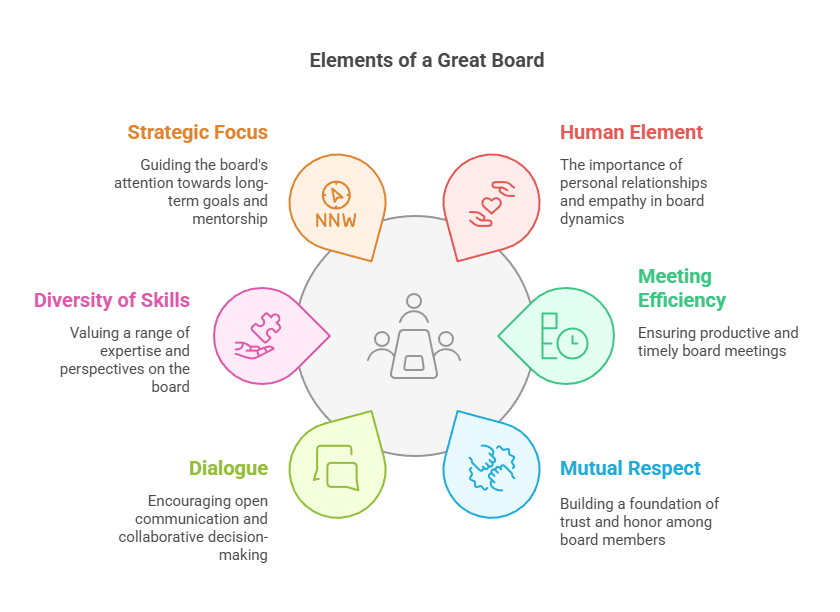
To harness the full power of a board, focus on the intangible dynamics: instilling mutual respect, fostering open dialogues, and committing to a shared sense of duty. In boards that master these traits, the sum of individual brilliance truly multiplies—fulfilling the promise of a top-performing, deeply effective governing body.
Ready to Act?
Contact us for a 15-minute free consultation. Email: sanjay@sankulinc.com Phone: 6472977025. www.sankulinc.com www.businessvaluegrowth.com
© 2025 [Sanjay Kulkarni, Sankul Enterprises Inc.] All rights reserved. This article is protected under copyright laws. Unauthorized copying, reproduction, or distribution is strictly prohibited. For permissions, contact above.
Disclaimer:
The information provided in this article is for general informational purposes only and does not constitute professional advice. While every effort has been made to ensure the accuracy of the information, it may not apply to specific situations. Readers are encouraged to seek personalized advice from a qualified professional regarding their unique circumstances. The author and publisher accept no responsibility for any decisions made based on this content.