
Forging Value: A CFO’s Guide to Manufacturing Finance & Valuation – 2
“Elevating Manufacturing Valuation & Strategy: A CFO’s Playbook (Part 2)”
Introduction
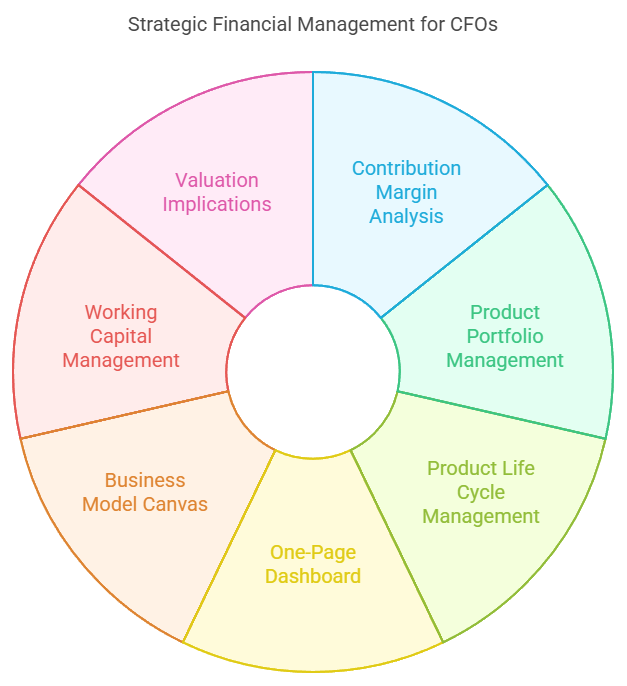
In Part 1, we explored the financial building blocks that every manufacturing CFO should master: from contribution margin to the life cycle mix. Now, we pivot to advanced frameworks (Business Model Canvas, Value Proposition Canvas) and the crucial roles of inventory and working capital. We’ll also highlight common valuation traps, especially when maturing product lines throw off deceiving levels of cash flow.
1. Business Model Canvas for Manufacturing
1.1 Mapping the BMC
- The 9 blocks: Key Partners, Key Activities, Key Resources, Value Proposition, Customer Segments, Channels, Customer Relationships, Cost Structure, Revenue Streams.
- In manufacturing, Key Activities might include sourcing raw materials, production runs, quality control, distribution. Key Resources can be specialized machinery, patents, or skilled labor.
1.2 CFO’s Perspective
- Cost Structure: Distinguish fixed vs. variable, highlight high-capex items.
- Revenue Streams: Evaluate if a B2B arrangement with a few giant clients leads to revenue concentration risk.
- Partner Ecosystems: Suppliers, logistic alliances—CFOs must watch potential supply chain bottlenecks or single supplier vulnerabilities.
1.3 Example
- A mid-sized electronics manufacturer mapped their BMC, discovered reliance on a single overseas raw material partner. The CFO negotiated a secondary domestic supplier, even at a slightly higher cost, to reduce risk and ensure consistent production schedules.
- Applying the Value Proposition Canvas (VPC)
2.1 VPC Basics
- Identify pains (operational inefficiencies? high scrap rates?) and gains (reduced downtime, lower cost of ownership) for your customer segments.
- Then align your product’s “pain relievers” and “gain creators” accordingly.
2.2 Manufacturing Twist
- Many manufacturing businesses produce components for OEMs. The “Job to be done” might be ensuring a certain quality standard or just-in-time delivery to avoid your customer’s line stoppage.
- CFO angle: If your product truly solves your customers’ biggest manufacturing headache, you can command better pricing or multi-year supply contracts.
2.3 Example
- A packaging manufacturer polled their top customers. Pain point: “Frequent line disruptions.” Gain: “Reliable, on-demand supply with minimal lead times.” By reorganizing production scheduling and buffer inventory, they locked in multi-year deals, stabilizing revenue forecasts for valuation improvement.
- Inventory Management & Working Capital
3.1 Inventory’s Double-Edged Sword
- Insufficient stock = missed sales; too much stock = idle cash + risk of obsolescence.
- CFO tip: Track inventory turnover and aging data. Segment them by product lines so slow-moving SKUs get flagged early.
3.2 Working Capital as a Growth Engine
- In manufacturing, working capital (inventory + receivables – payables) often consumes significant cash. Freeing up even 10% can finance expansions or new product lines.
- CFO approach: Negotiate better payment terms, adopt demand forecasting to keep inventory lean.
3.3 The Pitfall of Maturing Product Cash Flow
- A stable, mature product line might generate strong cash as growth flattens (less reinvestment). But if that product is near decline, this “extra” cash can be misleading for valuations, as future revenue may tail off quickly.
- Advice: Reinvest windfall in new product R&D or mitigate risk via diversification.
- Valuation Implications in Manufacturing
4.1 Distinguish Good Profit from Great Margins
- Some lines might show decent net income, but intangible risk factors (supplier concentration, outdated processes) could reduce the multiple an acquirer is willing to pay.
4.2 Tangible vs. Intangible Assets
- Machinery and real estate are easy to see, but brand reputation, proprietary processes, or intellectual property often matter more in modern manufacturing valuations.
- CFO tip: Document process innovations or R&D achievements that create intangible value—boosting potential exit multiples.
4.3 Normalization of Costs
- If the company owns the facility, “market rent” adjustments might be needed. If the product lines rely on specialized labor or raw materials from a sister company, normalizing those transfer prices is key to a fair valuation.
4.4 Efficient Working Capital
- Efficient use of working capital reduces the risk and, in turn, increases the value of the business. Excess working capital in the form of inventory or AR is discounted in valuation.
Conclusion & Key Takeaways
- BMC & VPC: Provide a strategic blueprint for customer-centric manufacturing.
- Working Capital & Inventory: Must be systematically managed to avoid liquidity crunches and seize growth opportunities.
- Valuation Traps: Over-reliance on a single mature product line, or ignoring intangible assets, can skew perceived value.
- Next Steps: Evaluate your manufacturing portfolio like an investment—using contribution margin, life cycle mixing, and strategic dashboards to ensure each product line’s viability and synergy.
Ready to Act?
If you want personalized CFO advice on optimizing your product lines, managing working capital, or raising your manufacturing firm’s valuation, contact me. With over 25 years in manufacturing finance, I can help shape a robust, future-ready operation.
For a 15-minute free consultation. Email: sanjay@sankulinc.com Phone: 6472977025. www.sankulinc.com www.Businessvaluegrowth.com
© 2025 [Sanjay Kulkarni, Sankul Enterprises Inc.] All rights reserved. This article is protected under copyright laws. Unauthorized copying, reproduction, or distribution is strictly prohibited. For permissions, contact above.
Disclaimer:
The information provided in this article is for general informational purposes only and does not constitute professional advice. While every effort has been made to ensure the accuracy of the information, it may not apply to specific situations. Readers are encouraged to seek personalized advice from a qualified professional regarding their unique circumstances. The author and publisher accept no responsibility for any decisions made based on this content.